

Clinical Perspective
For 24 Years I Gave Diabetic Patients The Wrong Answer About Their Burning Feet.
From a registered nurse and certified diabetes educator who spent two decades giving patients a framework that had a gap in it nobody in her institution ever thought to look for.
“Get your A1c down and the burning will follow.” I said that for twenty-four years.
I said it to women who were doing the work — who were changing what they ate, monitoring their numbers, taking their medication, losing the weight — and still lying awake at night with feet that felt like they were resting on a radiator. I said it with confidence, because that’s what my training, my colleagues, and the clinical framework I worked inside all said to say.
I was a registered nurse and certified diabetes educator for twenty-four years in community health. I saw this in sixty or seventy patients a year. And the honest thing I can tell you — the thing I didn’t say in those appointments — is that I did not have a good answer for the burning itself. The blood-sugar framework was doing what it was designed to do. The burning feet were a different problem. Nobody in the system I worked inside had put that question on any form I ever used.
I left clinical practice two years ago. What I know now about the burning in diabetic feet — what I wish I had known twenty years earlier — is what this article is about.
Twenty-four years. The same folder.
My name is Sandra Holt. For twenty-four years I worked as a registered nurse and certified diabetes educator at a community health center, primarily serving low-income adults with Type 2 diabetes.
I ran the diabetes education program. I trained clinical staff. I sat with patients in appointment rooms with a chair for them and a chair for the person delivering information about their numbers. I was usually in the second chair.
Over the years I kept an informal folder. Cases that came back. Women who were doing what the framework asked and returning, month after month, with the same burning feet.

Twenty-four years in rooms like this one. A different chair, but the same chart, the same answer, the same folder.
I stopped adding entries to that folder two years ago.
Not because the patients stopped coming.
What I kept seeing that the system didn’t have a form for
Three patients. Not by name. By the picture they made when they sat across from me.
The first was in her early 60s, eight years into Type 2 diabetes, A1c at 7.0% after working it down from 9.4% over three years. She came to see me six times over two years. Each time the burning was buried in the general update — the way patients bury things they have asked about before and received no useful answer for. She managed it with thick socks and a fan on her bedside table even in December. I gave her the same answer six times.
The second was in her late 50s. She had brought her A1c from 9.2% down to 6.8% over eighteen months — a result that would appear as a success in any outcome summary. She described the burning getting worse as her numbers improved. Not better. She was not wrong to find this confusing.
In the second year of working with her, she came in for a routine follow-up. Her A1c was the lowest it had been in her adult life. She folded her hands on her lap and said:
She was not asking a question.
I gave her the same answer I had given before. She nodded. We moved on.
I drove home thinking about the folder.
A third patient, 67, fourteen years with diabetes, described the burning as standing on hot pavement from the inside. She was no longer asking me to fix it. She was asking me to explain it.
I could not.
That absence was not something I marked in the chart.
What the system consistently offered
Compression socks. A dietary counseling referral. That was the standard response to a burning-feet complaint that fell outside the obvious clinical pathway — no open wound, no significant peripheral vascular disease, A1c within target. We documented the referral. The patient left with socks.
For patients where the evaluation warranted it, a podiatry referral for neuropathy assessment. The podiatrist would confirm the burning was nerve-related, document the sensory finding, and make no recommendations specific to the burning itself, because sensory neuropathy in a patient with a managed A1c was not a condition with a defined podiatric treatment pathway. Patients I sent to podiatry typically paid between $120 and $180 for a diagnosis they already had.
For patients where the burning had become severe enough to warrant medication, gabapentin. I watched this work for some patients and flatten others. The ones it flattened described it in very similar language: fog, fatigue, the sense of having traded one problem for a version of something they liked less. Several stopped the medication on their own. Several did not, because the alternative was worse.
Women I saw had typically spent $150 to $300 on compression products, cooling creams, and pharmacy recommendations before arriving at my program. They left with a dietary counseling referral and an A1c target.

Every laminated chart the system offers. The burning feet were not on any of them.
Then there was the consulting cardiologist.
He visited quarterly to review our cardiovascular risk patients. He had the particular confidence that accumulates from institutional affiliation and from not being frequently in a room where his confident pronouncements were tested against weekly appointment data.
I raised the question during one of these sessions. I had been seeing the pattern too consistently to continue filing it under “monitor and adjust.” I described it specifically: well-controlled patients, A1c under 7.5%, ongoing burning that did not follow glycemic improvement.
He listened. Then he said: “If their A1c is under 7, they shouldn’t have significant neuropathic symptoms.”
He said it with the confidence of someone who was not reading my appointment notes.
I wrote it down. That evening I opened the folder.
I counted sixty-three entries.
He was wrong in a way the system I worked inside had no mechanism for correcting, because the correction would have required reading the data that he was not reading — data from appointment rooms he had not been in.
A Tuesday evening in February
I left the clinic two years ago. I had not decided to look for something else. I had reached a point where I did not want to give that answer one more time.
The folder had 200 entries.
The breaking point was not dramatic. A Tuesday evening in February. I was at home reading research out of habit. A colleague had mentioned palmitoylethanolamide in passing at a training session months earlier, and I had not followed up. That evening I searched it.

Pickering et al., 2022. The abstract she read twice and the note she made before she knew what to do with it yet.
The first result was Pickering et al., 2022. A randomized controlled trial. Diabetic peripheral neuropathic pain. I read the abstract twice.
I made a note.
I did not feel anything dramatic. I felt the specific quiet of noticing something that had been there and had not been asked about.
What three months of reading found
Over the following three months, I read everything I could find.
I started with the mechanism literature: the PPAR-alpha pathway, the mast cell and glial cell research, the depletion hypothesis. These were peer-reviewed papers, many from Italian research groups working with this compound since the 1990s. I pulled the Pickering 2022 trial in full. I read the Lang-Illievich 2023 meta-analysis in Nutrients: 774 patients, a statistically significant effect size. I cross-referenced the Hesselink 2015 nerve-compression review. I called a colleague in functional neurology who I knew would tell me plainly if I was misreading the evidence. He did not tell me I was misreading it.
The skepticism I brought to the search was real. I had spent twenty-four years in a clinical system that was appropriately cautious about supplement claims.
My first reaction was not excitement. It was something quieter than that, and harder to name.
What the research actually says, and what it means in plain language
What I eventually concluded — after three months with the literature and a colleague who could find no fault in the reasoning and two returns to the mechanism papers to verify I was reading them correctly — was this.
The compound is palmitoylethanolamide. The body produces it. Its function, as the research establishes, is to quiet overactive nerve pain signals. The specific problem for the patients I had been seeing — the ones with burning that persisted after glucose control was achieved — is stated in the mechanism as follows.
I translate this into a practical image. Think of it like a brake pad that has been riding too hard for too long. Blood sugar control removed the road conditions that caused the wear. But the brake material itself was already gone. And nothing in the diabetic care framework I practiced for twenty-four years was designed to restore it.
That is the gap. The glucose framework addressed the source of the irritation. It was not designed to address the depletion the irritation had already produced. These are different problems. They require different approaches. The system I worked inside had tools for one of them.
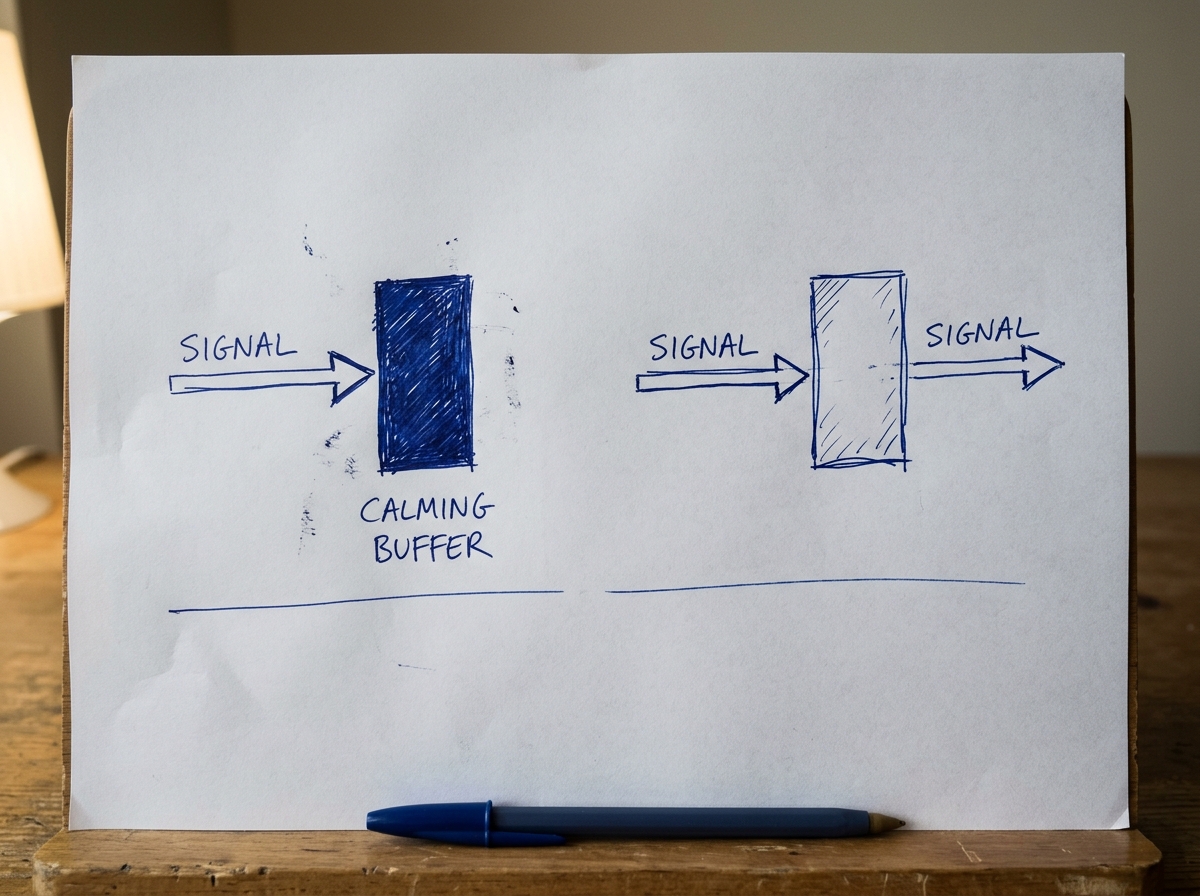
The brake pad. What blood sugar control addresses. What it does not replenish.
Readers ready to assess the formula and trial terms →
The gap the framework was never built to see
The diabetic management system does what it was designed to do. I want to say that plainly because it is accurate. It manages blood glucose. It tracks complications. It documents risk. Within its design scope, it is a well-organized and evidence-based system.
What it was not designed to do is ask about palmitoylethanolamide. Or about what sustained metabolic stress over years may do to the body’s endogenous capacity to regulate nerve pain signals. These are not questions the blood panel covers. They are not questions the quarterly check is built to ask.
So they go unasked.
I spent twenty-four years inside that system. I used its tools. I used them correctly. The gap was never that the practitioners were wrong — it was that the framework was built around what could be measured with the tools it had. The depletion of an endogenous nerve-calming compound was not on the test menu.
The patients I saw for twenty-four years were not wrong to trust what the system offered them. Neither was I, for most of those years.
The gap was always there. We simply had not been given a name for it.
What I shared with two patients, and what happened
The product I eventually shared with my first two former patients was Youfirst PainBloc PEA 600mg.
I want to be precise about how I framed it when I shared it. This is a dietary supplement. It is not a treatment for diabetic neuropathy. What the published literature suggests it supports is the body’s own nerve-calming system — the same system the mechanism research indicates may become depleted under sustained nerve irritation. The 600mg dose matched the dose used in Pickering 2022. The product’s stated formulation is micronized, which addresses the absorption limitation that the standard PEA formulation presents.
The second patient I shared it with. Type 2 for six years. At week four she sent me a text. It read: “First time in three years I slept past 5am without the feet waking me.”
Type 2 for twelve years. Her burning had been rated, by her own consistent account over two years of follow-ups, at a 7 most nights. By week six she described it as a 2 or 3 on most nights. Her husband called me. He said she had slept past 5am for the first time in longer than he could specifically remember.

Barbara’s husband called Sandra at week six. She had slept past 5am for the first time he could remember.
The same direction, across two different patients, with two different disease durations: sleep onset improved before burning intensity changed. The timeline in both cases ran: sleep quality first, pain reduction following. This matches the trajectory described in the Pickering 2022 and Lang-Illievich 2023 datasets.
Neither of these is a clinical trial. I want to be clear about that. Two patients does not establish efficacy. What these two cases established, for me, was enough reason to continue recommending that former patients with this specific profile look into it — with the explicit instruction to discuss it with their current physician before adding anything to their regimen.
There are specific things I note for patients managing a full diabetes medication load. PEA does not interact with metformin, insulin, or the most commonly prescribed diabetic medications in the published literature. It is not sedating — a distinction that matters for patients who have tried gabapentin and described losing the cognitive quality of their days alongside the pain. Across the 20-plus trials in the literature I reviewed, no serious adverse events were reported, and the dropout rate was consistently lower than in the placebo arms.
For a population already managing a chronic condition and a complicated medication schedule, a low-risk adjunct with a plausible mechanism and a reasonable evidence base is worth knowing about. That is my honest assessment.
Where to find the formulation, and what I can and cannot tell you
Readers who want to access the full formula, the study citations, and the trial terms for Youfirst PainBloc PEA 600mg can find them at: youfirstlab.com/products/pea600
Subscription pricing: $29.99 for a single bottle monthly. Buy 2 Get 1 Free subscription: $59.99. One-time purchase: $39.99 per bottle, or $79.99 for the Buy 2 Get 1 Free option.
The manufacturer offers a 90-day money-back guarantee. That is a reasonable evaluation window. The mechanism research, across both the Pickering 2022 trial and the 2023 meta-analysis, suggests a meaningful response in most cases between weeks four and eight. Ninety days covers two full evaluation windows with time to reassess. It is the window I would have advised patients to use if I had been in a position to recommend this earlier.
I am not the right person to tell you whether to take a supplement. That is between you and your physician. What I can tell you, as someone who spent twenty-four years giving diabetic patients a framework for the burning that did not include this, is that the literature is real enough to be worth a conversation.
Readers ready to assess the formula and trial terms:
Access the Formula & Trial Terms →90-day money-back guarantee • Subscription $29.99/month • One-time $39.99/bottle
The published research suggests meaningful response between weeks four and eight. 90 days covers two full trial windows.
If you are waiting for the diabetes management system to add this question to the quarterly form, I was that system for twenty-four years. The A1c targets are on the form. The depleted nerve-calming compound is not. That is unlikely to change soon.
youfirstlab.com/products/pea600
P.S. I stopped adding entries to the folder two years ago. Not because the patients stopped coming. Because when Barbara called at the end of week six and described what her nights looked like, I realized I had a different answer to put in it — not in the folder, but for the next woman who sat across from me in an appointment room and said: “You told me if I got my numbers down the burning would ease.”
For twenty-four years I said: get the numbers lower and see what follows.
I do not say that anymore.