
Personal Health Story
She Fixed Her Blood Sugar. Nobody Told Her About The Other Problem.
By someone who spent nine years blaming her blood sugar for something her blood sugar wasn’t actually causing.
My glucometer said 6.9. Excellent progress, my educator said. My feet were still on fire at three in the morning — because nobody who told me to get my numbers down ever checked whether that would actually fix the burning.
I’d worked two years for that number. Changed how I ate, took the metformin, went to every follow-up. And the burning — the burning that had been keeping me up since my diagnosis — was supposed to ease as my A1c came down. That’s what I was told.
The burning did not ease.
Four years of frozen gel packs. Four years of feet hanging off the edge of the mattress. Four years of sitting in appointments where someone called my progress excellent and then sending me home with the same feet I came in with. Every time I mentioned the burning, I got a different version of the same non-answer: get the numbers lower, wait a little longer, give it time.
Nobody asked a different question.
What I eventually found — after those four years — has nothing to do with blood sugar. It has to do with a system running alongside the one my doctors were managing, a system nobody in that clinic ever put on the form.
That story starts with who I am and what I’d already spent trying to fix this before I found it.
Nine years. One lever. One answer.
My name is Carol Dietrich. I have lived in the same ranch house for twenty-two years. I have had Type 2 diabetes for nine.
There is a part of this story I am not going to tell you — whether I am still on the metformin, what my current numbers look like, the specifics of what I am doing now that differs from then. That is between me and my doctor.
What I can tell you is that for nine years I was given one framework for managing what was happening in my body. One lever. I pulled it as hard as I could.
The burning in my feet did not care.
What nine years on the same treadmill looks like at 2am
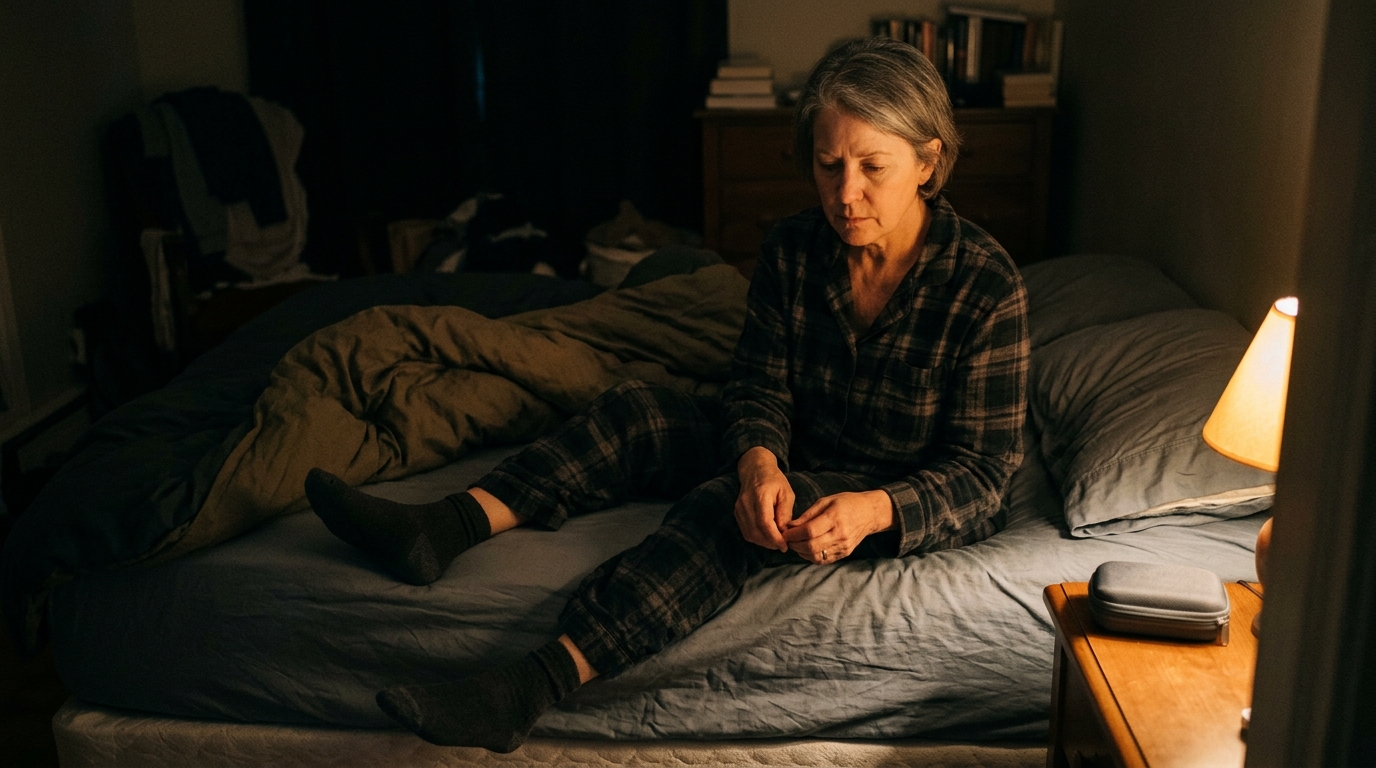
The burning had a schedule. It would begin around nine in the evening, a warmth first, then something sharper. By eleven it was predictable. By midnight I had both feet off the edge of the mattress so nothing was pressing against them. By two in the morning I was in the kitchen with the gel pack from the freezer against my ankles, waiting for it to take enough of the edge off to get back to sleep.
Every night.
The next day I ran about three seconds behind everything. Not tired the way sleep deprivation is usually described. Slower. I would start a sentence in a Monday morning call and lose the middle of it while I was still talking. I learned to ask a follow-up question in the pause, because that looked like listening instead of stalling.
In July 2023 I went to my sister’s house for her daughter’s birthday. Her floors are old hardwood that warms up in summer. I was wearing wool socks inside, because I had learned that bare feet on a warm floor amplified something in the burning. She asked why.
I started to say something. Then I took a drink instead.
She did not ask again. I had learned that about people by then. If you change the subject fast enough, they stop asking.
What I had not yet understood was how many subjects I had changed, and in how many rooms.
What $205 bought me
The cooling gel insoles were $24. Two sets, because one needed to refreeze while I used the other. They helped for about forty minutes.
The lidocaine cream was $29 per tube, two tubes across six weeks. The pharmacist was confident. I was not, by the end of it. Fifty-eight dollars total, for the privilege of feeling it work for one hour and then having my feet be exactly what they were before.
A supplement called NerveEase Complete — benfotiamine, alpha-lipoic acid, B12, a chart on the label showing nerve health pathways. Two months, $38 per month. Nothing changed. I threw the third bottle away before I ordered it.
Diabetic compression socks. $47. For swelling I did not have. The burning was untouched.
Two hundred and five dollars. To end up in the same kitchen, at the same hour, with the same frozen gel pack.

Two hundred and five dollars. And then one appointment where she handed me a chart and called it a direction.
Then there was my diabetes educator.
Her name was Sarah. She was in her mid-forties, efficient, with the kind of confidence that comes from having delivered the same correct information many times. The appointment room had a whiteboard on one wall and a rack of laminated guides near the door: carb-counting charts, shoe care instructions, the foot inspection sheet. Everything correctly organized.
I had been her patient for two years. My A1c was at 7.1 and dropping. She knew this.
I waited until the end of the appointment to ask about the burning. I had been holding the question back because it felt like the kind of thing that would suggest I was not focused on the main objective.
I described it. The nightly schedule. The midnight-to-2am window. The feet off the mattress. The gel pack.
She made a note. Then she looked up and said: “The nerve discomfort typically improves as glycemic control improves. You’re heading in the right direction.”
She clicked her pen and moved to the next item on her list.
I drove home not crying. I was something past crying. I had spent two years working toward a number she called excellent progress. The burning was going to follow when it was ready. That was the information I was expected to carry home, and she was onto the next item on her list.
The lawn I stood at the edge of
In September, my daughter brought my granddaughter to visit. She is five. She wanted to run barefoot in the backyard grass and she wanted me to come.
I said my knees were bothering me.
She accepted this. She has no reason yet to disbelieve the women in her family.
My daughter watched from the doorway. She did not say anything.
I stood at the edge of the door and watched my granddaughter run and understood, with a clarity that had no emotion in it, that I had been telling this story wrong.
The story I told was: I am managing this. The numbers are improving. The burning will follow.
The actual story was: I was standing inside a door, telling a five-year-old my knees were the reason I could not come.
Those were not the same story.
The post I almost scrolled past
That night I did something I had not done in over a year. I opened my phone after midnight and searched.
Not for A1c information. I typed something about burning feet and diabetes and whether there was an option beyond waiting for the numbers to fix it. I found a forum. Someone had described the exact pattern: the nightly schedule, the midnight-to-2am window, the feet off the mattress. The replies were from people with the same thing. One mentioned a compound the body produces naturally. A fatty acid amide. Something the body makes, not something pharmaceutical. I had never heard of it.
I almost kept scrolling.
The reasons against it were immediate. Another supplement. Another set of claims. I had spent over two hundred dollars on things with mechanisms and charts on the label. My A1c was moving in the right direction. Maybe that was actually going to be enough. Maybe I needed to wait longer.
I bookmarked the page. I did not order anything that night.
But I came back to it twice before the week was out.
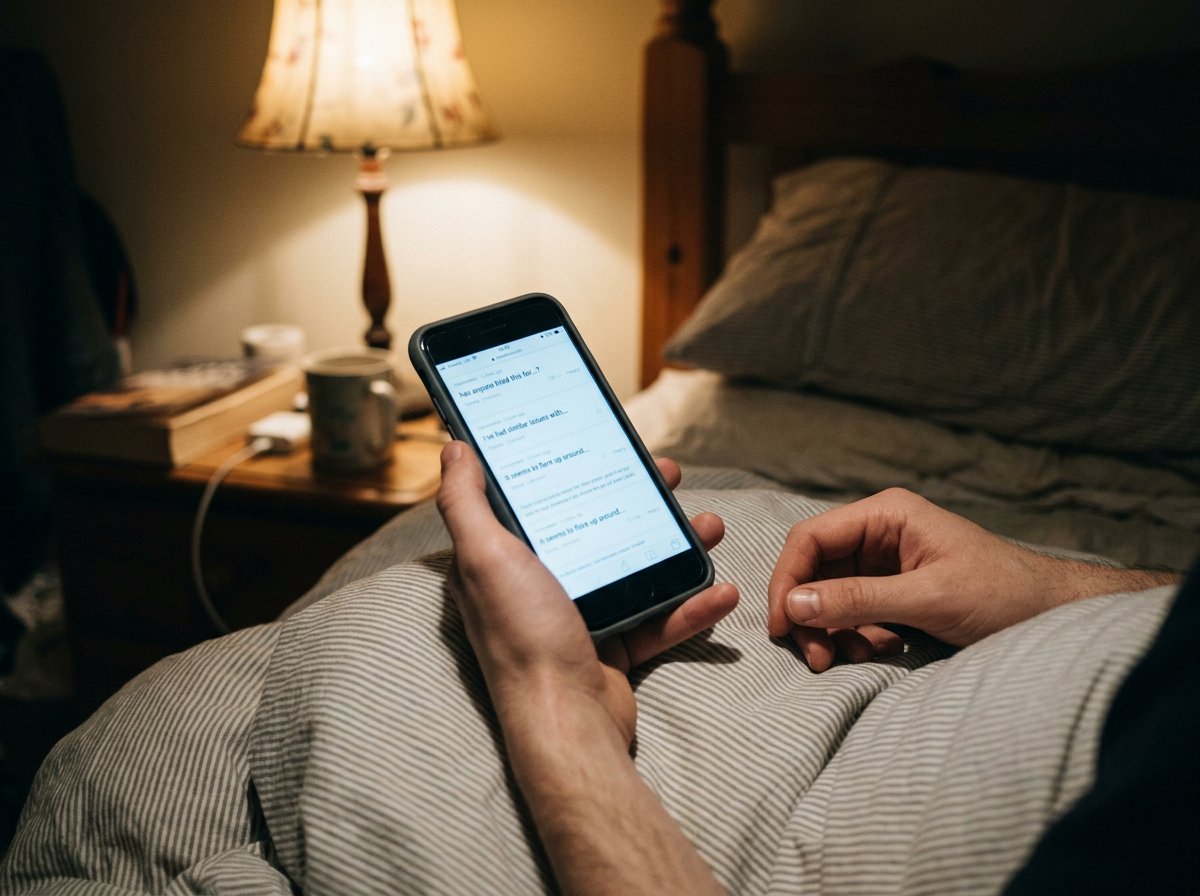
The thread she almost scrolled past. The reply that used words her doctor never had.
Why nothing I tried could reach the brake
The third time I came back to that page, I read a reply I had skimmed past twice. It described a compound the human body makes specifically to quiet overactive nerve signals. Not a painkiller. Not something blocking the pain from the outside. Something the body was supposed to make on its own.
And here is what it said, and what I eventually found confirmed in more places than I expected.
Think of it like a brake pad that has been riding too hard for too long. Blood sugar control stopped the road conditions that caused the wear. But the brake material itself was already gone. Nothing I had tried — not the lidocaine, not the gel pack, not the two months of neuropathy formula with the charts on the label — ever reached the brake. They all worked on the road.
I read it twice. Then I went and found the name of the compound and looked up the clinical trials.
And then I understood, for the first time, why every answer I had been given was the only answer the system giving it was built to produce.
If you’re already certain — this is where I order it →
The form with the missing box
The diabetes management system has one lever. Get the A1c down. What follows from that lever is tracked quarterly: the blood test, the dietary referral, the foot inspection form with its boxes for circulation, sensation, wound prevention.
The burning feet are mentioned in the literature. They are acknowledged as a complication. There is a clinical pathway for them.
The pathway leads back to the A1c.
What is not on the form is the depleted nerve-calming compound. It has no equivalent blood test. No quarterly check exists for whether your body is producing enough of its own pain-quieting compound to keep up with what years of nerve irritation have been demanding. So it goes unmeasured. And unmeasured means it goes unaddressed.
The women who trusted that form were not wrong. The form was built by people trained on it, validated by institutions that funded the research inside it. You do not go looking for gaps in the framework everyone around you is using.
I was not stupid for trusting it.
The system is not broken. It was built this way.
What I ordered, and what happened by day four
I ordered one bottle.
I told myself thirty days. That was the deal I made with the part of me already drafting the internal argument about why this would be like everything else.
The product was Youfirst PainBloc PEA 600mg. Six hundred milligrams of the same compound I had been reading about. Micronized, which the research suggested improved uptake at this dose. Non-sedating — that mattered to me after years of hearing about gabapentin fog from people in the same forums. My pharmacist looked it up and had nothing to flag.
The package came on a Thursday. I started that evening.
By day four — Sunday — I noticed a gap. Not a change in sensation, exactly. More like the specific absence of something I had stopped hearing because it had been constant for so long. The feet were still warm. But I had not repositioned them in the night. I could not remember getting up. The gel pack was still in the freezer where I had left it.
By the second week I stopped putting the gel pack in the freezer before bed. I did not decide to stop. I just did not do it one night, then the next, and by Wednesday I realized it had been sitting untouched for five days.
The third week, my daughter called. She had seen a photo I had texted her. The bedroom, the dog, nothing particular. She said: “Both feet are under the covers.” She said it the way you say something you have been watching for a while and were waiting to be allowed to mention. I had not thought about the duvet. It was just where it had ended up.
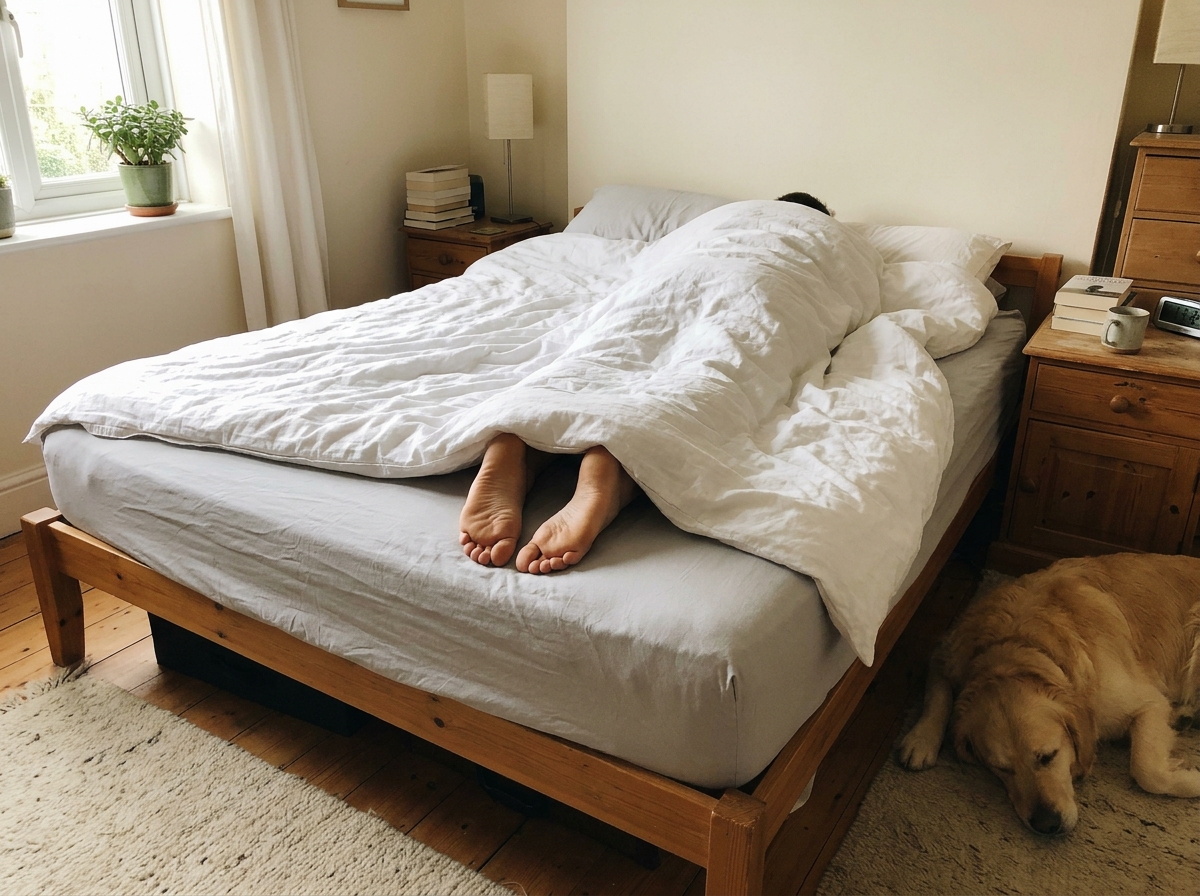
Third week. Both feet under the covers. She hadn’t thought about the duvet. It was just there.
I told a woman named Sandra from the forum what I had been taking. She was 64 years old, Type 2 for nine years, same burning, same doctor’s answer. Six weeks later she texted me at 6:14am: “Three years since I slept past 5:30.” Then: “Thank you.”
The gel pack is still in the freezer.
I have not used it.
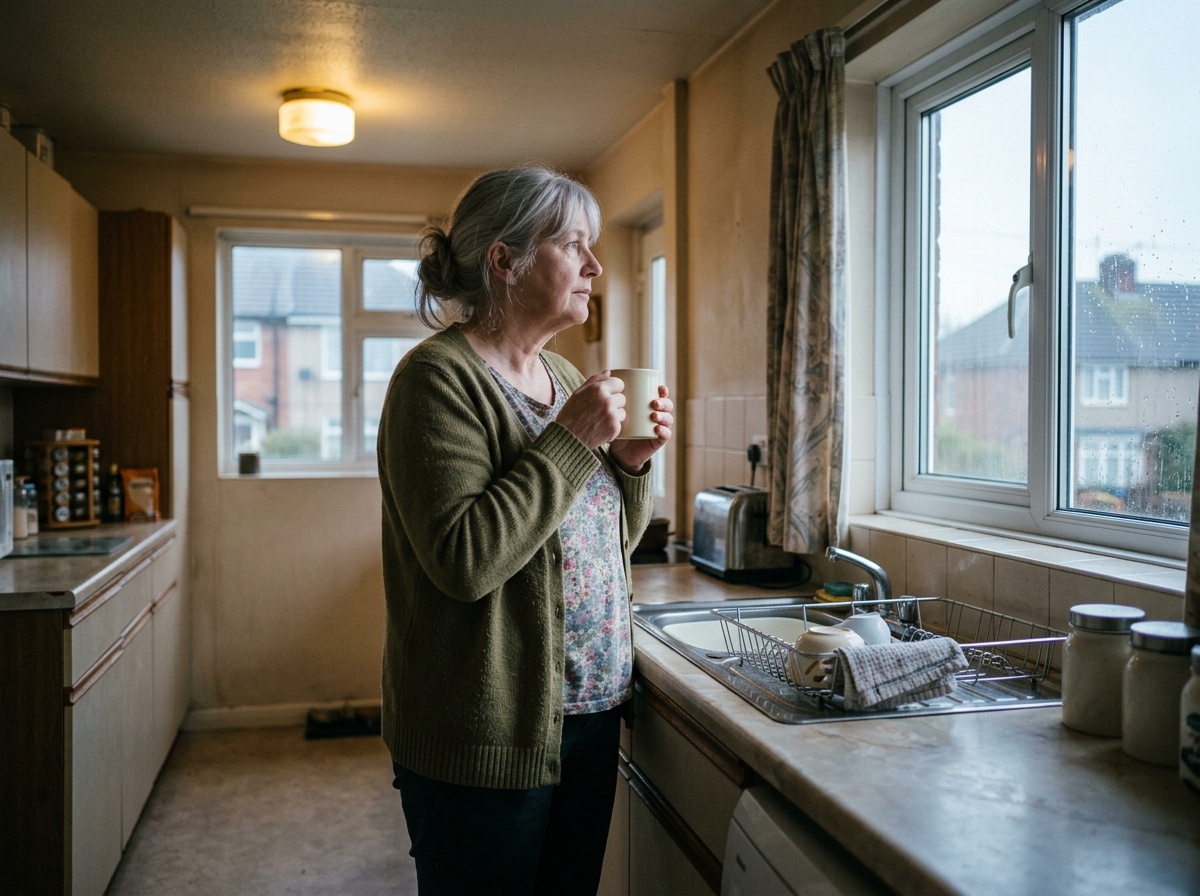
The morning after a night when nothing needed managing. The kitchen was there when she got up.
What to do if this is your situation too
If you are at the place I recognize — good numbers, burning feet that have not followed, appointments where someone calls your progress excellent — there is one thing I want to say before I tell you where to find this.
I did not expect to be writing about a supplement. I am still not entirely comfortable with that description of myself. But I spent nine years doing everything the system asked, and I am writing this from a bedroom where the gel pack has not been touched in four months. So here we are.
The product is Youfirst PainBloc PEA 600mg. Micronized formulation. Six hundred milligrams per capsule, matching the dose in the clinical research.
A subscription runs $29.99 a month. There is a Buy 2 Get 1 Free option at $59.99. A one-time bottle is $39.99, or Buy 2 Get 1 Free for $79.99. I spent $205 on things that did not work before I spent my first $29.99 on this. I am mentioning that not to persuade you but because it is a fact about this problem, and you likely have your own version of it.
The guarantee is ninety days. Full refund, no questions asked. That is more than enough time. I knew by week three, if I am being honest, though I waited another three weeks before I was willing to say it. Ninety days covers two full trial windows with room to spare.
Now the honest part. Not everyone on that forum had the same experience. Some people reported it taking six to eight weeks rather than three. A few said the improvement was there but less dramatic than what I described. I can only speak for myself and for Sandra. What I can say is that after nine years of one answer and over two hundred dollars spent in the wrong direction, what happened to me was worth considerably more than thirty dollars a month.
If you want to try what I take:
Try What I Take →90-day money-back guarantee • Subscription $29.99/month • One-time $39.99/bottle
No questions asked if it doesn’t work for you. Ninety days covers two full trial windows.
Try what I take: youfirstlab.com/products/pea600
P.S. The last thing I thought about before I placed the order was the form on my diabetes educator’s wall. The foot inspection sheet. I had signed it probably sixteen times over four years. It had boxes for circulation, sensation, wound prevention. No box for the burning that happened at night. No box for whether the body’s own calming system was keeping pace with what the years of irritation had demanded. The form was not going to grow a new box. That was the thing I finally understood. The only question was what I was going to do with mine.